FEARLESS SECRETS
Outer Self / Inner Voice
What happens when you can finally see
the voice in your head?
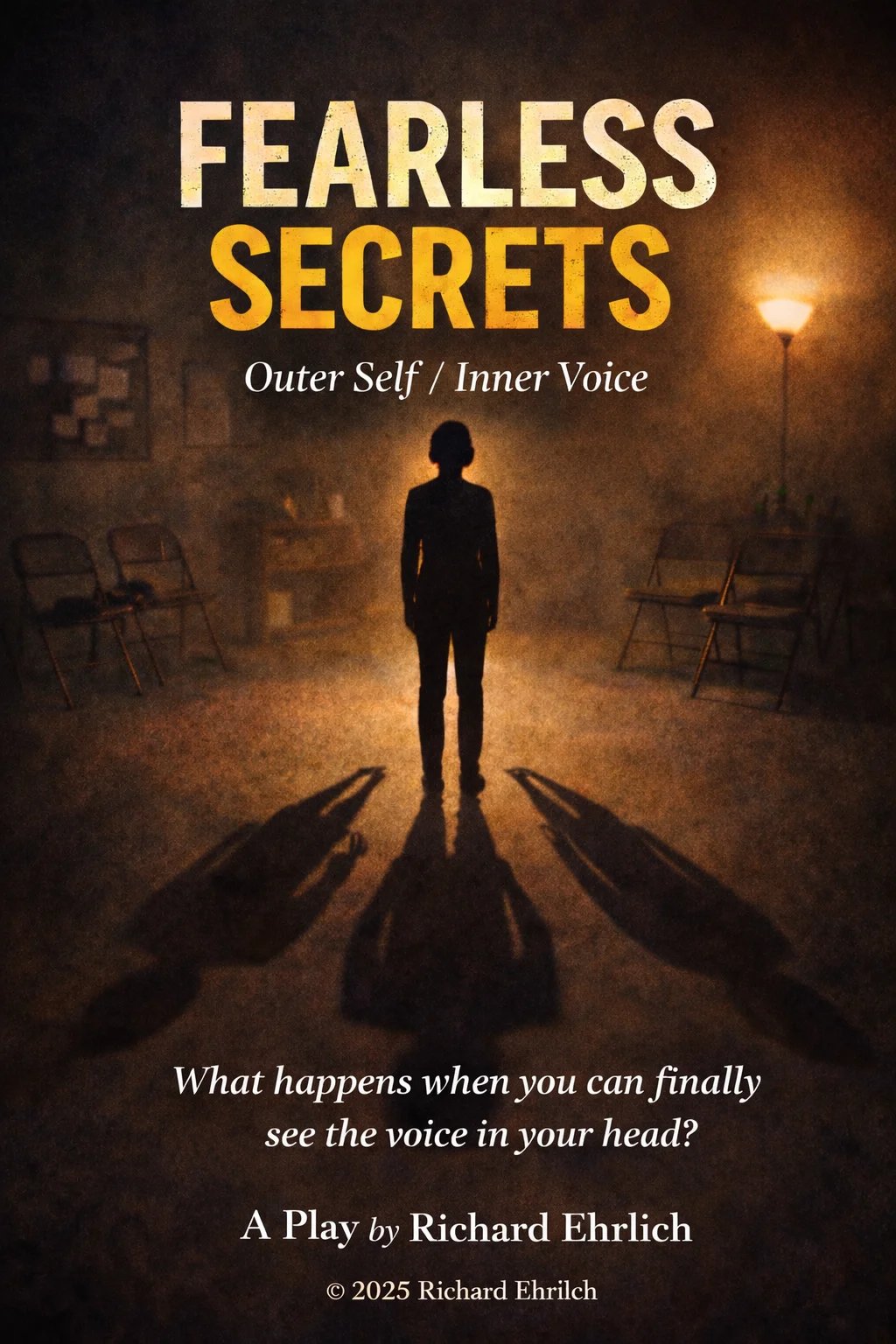
Outer Self / Inner Voice
What happens when you can finally see
the voice in your head?
FEARLESS SECRETS: OUTER SELF / INNER VOICE
A Contemporary Play by Richard Ehrlich
SYNOPSIS
Eight strangers walk into a community center fundraiser. Sixteen actors walk onto the stage.
In FEARLESS SECRETS, inner dialogue becomes visible theater. Through revolutionary dual casting, each of the eight characters exists simultaneously as two performers: the OUTER SELF—the carefully managed persona we present to the world—and the INNER VOICE—the relentless internal critic that never stops speaking. What we usually hide in our heads now stands beside us on stage, commenting, contradicting, and complicating every social moment.
AVA, the event organizer, has spent months planning this final fundraiser before the community center closes. Eight guests arrive, each performing their own version of social acceptability. But when MARK—whose Inner Voice speaks with brutal honesty—challenges the group to drop their performances, the evening takes an unexpected turn. A fire alarm malfunction locks all sixteen performers inside for forty-five minutes of real time. Trapped together with their inner critics fully visible, the distance between what people say and what they think begins to collapse.
As social scripts fail and authentic moments break through, the play asks: What happens when you can finally see the voice in your head? And what becomes possible when others can see it too?
Set during a single evening with no intermission, FEARLESS SECRETS is theatrical chamber music—intimate, immediate, and unrelenting in its examination of how we perform ourselves into isolation and what it costs us.
Production Details:
Cast: 16 performers (8 characters × 2 roles each)
Running Time: 85 minutes continuous (no intermission)
Setting: Community center meeting room, single evening, real time
Genre: Contemporary psychological drama
Contact Information:
Richard Ehrlich
Email: rdedds@hotmail.com
Website: richardehrlich.net
FEARLESS SECRETS: OUTER SELF / INNER VOICE
A Contemporary Play by Richard Ehrlich
ABOUT THE PLAY
SYNOPSIS
Eight strangers walk into a community center fundraiser. Sixteen actors walk onto the stage.
In FEARLESS SECRETS, inner dialogue becomes visible theater. Through revolutionary dual casting, each of the eight characters exists simultaneously as two performers: the OUTER SELF—the carefully managed persona we present to the world—and the INNER VOICE—the relentless internal critic that never stops speaking. What we usually hide in our heads now stands beside us on stage, commenting, contradicting, and complicating every social moment.
AVA, the event organizer, has spent months planning this final fundraiser before the community center closes. Eight guests arrive, each performing their own version of social acceptability. But when MARK—whose Inner Voice speaks with brutal honesty—challenges the group to drop their performances, the evening takes an unexpected turn. A fire alarm malfunction locks all sixteen performers inside for forty-five minutes of real time. Trapped together with their inner critics fully visible, the distance between what people say and what they think begins to collapse.
As social scripts fail and authentic moments break through, the play asks: What happens when you can finally see the voice in your head? And what becomes possible when others can see it too?
Set during a single evening with no intermission, FEARLESS SECRETS is theatrical chamber music—intimate, immediate, and unrelenting in its examination of how we perform ourselves into isolation and what it costs us.
THE INNOVATION: DUAL CASTING AS DRAMATIC STRUCTURE
FEARLESS SECRETS makes inner dialogue physical and immediate through unprecedented dual casting. This is not a theatrical gimmick—it's the play's central dramatic engine.
Each character lives on stage as two distinct performers:
• The OUTER SELF navigates social interaction with learned grace
• The INNER VOICE provides running commentary filled with doubt, judgment, and fear
The Inner Voices don't whisper from the wings—they stand center stage, interrupt conversations, and speak directly to the audience. They're rude. They're terrified. They're painfully honest. And unlike our actual inner critics, these ones can be seen by everyone.
This creates immediate dramatic tension: How do you maintain social performance when your anxious thoughts are visible to the room? The structure forces audiences to witness not just what characters do, but the exhausting effort of doing it.
THE THEATRICAL EXPERIENCE
FEARLESS SECRETS functions as theatrical claustrophobia. The play occurs in real time during a single evening, in a single room, with a ticking clock. A fire alarm malfunction creates the pressure cooker: forty-five minutes where leaving is impossible and the social facades everyone maintains begin to crack.
The dual casting creates layers of performance:
• Characters perform for each other (social scripts)
• Inner Voices perform internal criticism (self-judgment)
• Both perform the tension between the two (human experience)
As the evening progresses and social norms break down, something unexpected emerges: moments of genuine connection that would have been impossible while everyone was performing safety.
THEMES AND TERRITORY
At its core, FEARLESS SECRETS examines the voices we carry and the isolation they create. The play explores:
Social Performance and Authenticity
The exhausting work of managing how we appear versus who we are. Each character arrives practiced in their own particular performance—professional competence, casual confidence, self-deprecating charm. The play dissects these performances without judgment, revealing both their protective function and their cost.
Internal Criticism and Self-Sabotage
The Inner Voices embody the relentless self-criticism that shadows daily life. They catastrophize social moments, predict rejection, and undermine genuine connection. By making this internal dialogue external and visible, the play creates immediate empathy: everyone recognizes these voices because everyone has them.
The Collapse of Distance
The title's promise: fearless secrets. What happens when the distance between inner and outer life collapses? The play doesn't offer easy answers—some revelations create connection, others create pain. But it argues that the performance of invulnerability costs us more than vulnerability ever could.
Community and Witnessing
As the fire alarm keeps everyone trapped, the play becomes about what it means to truly see and be seen. Not the curated version we present, but the whole complicated truth. The community center setting matters: this is a space built for gathering, now forcing a different kind of coming together.
PRODUCTION CONSIDERATIONS
Cast Requirements
16 performers (8 Outer Selves + 8 Inner Voices)
Gender-flexible casting throughout
Dual roles require actors who can work in true partnership
Technical Demands
Single set: community center meeting room
Real-time structure demands precise pacing
Lighting design crucial for managing dual presence
Sound design for the fire alarm becomes a character
Running Time
85 minutes continuous (no intermission)
The real-time structure is essential to the claustrophobic tension
ABOUT THE PLAYWRIGHT
RICHARD EHRLICH
Richard Ehrlich is a playwright and composer whose contemporary theatrical works explore neurodiversity, mental health, family dynamics, and the spaces where internal and external lives collide. His plays combine psychological realism with formal innovation, creating visceral theatrical experiences that make the invisible visible.
FEARLESS SECRETS: OUTER SELF / INNER VOICE marks Ehrlich's most ambitious structural experiment: a full-length play in which each of eight characters is portrayed by two actors—the Outer Self and the Inner Voice—literalizing the gap between what we show and what we feel. The play examines social performance, anxiety, and the cost of maintaining invulnerability in an age of curated selves.
THEATRICAL WORKS
Ehrlich's body of work demonstrates consistent interest in making internal experience external and theatrical:
ALL AT ONCE! - A contemporary musical exploring ADHD and neurodiversity through the story of a family navigating diagnosis, treatment, and acceptance. The eight original songs integrate directly into the dramatic action, using musical form to express the chaotic energy of a neurodivergent mind.
TONIC: FINDING EUPHORIA - An 80-minute musical that follows individuals in a mental health support community as they navigate depression, recovery, and the search for sustainable joy. The play examines mental health treatment, pharmaceutical intervention, and the ongoing work of maintaining wellness.
THE BREATH: COMING HOME - A musical examining immigrant community surveillance in post-9/11 America. The play follows multiple generations of a Muslim-American family as they negotiate belonging, suspicion, and the performance of patriotism.
THE WEIGHT - A full-length drama about family caregiving that follows siblings navigating their mother's decline over a single weekend. The play examines the emotional and practical weight of eldercare, sibling dynamics under pressure, and the questions families don't ask until crisis forces them.
BACKGROUND AND PERSPECTIVE
Ehrlich brings a unique perspective to theatrical storytelling. After a 45-year career in dentistry, he transitioned to full-time creative work, bringing decades of observation about how people present themselves professionally while managing private struggles. This dual awareness—the gap between the face we show and the experience we have—infuses his theatrical work.
His plays often explore the performance of functionality: characters managing mental health conditions, navigating neurodivergent experience, maintaining caregiving responsibilities, or sustaining social presentation while internal systems strain. This interest stems from recognizing that most people are performing competence while barely holding on—and that the performance itself costs something.
Now based in New York City, Ehrlich writes with the urgency of someone who came to playwriting later in life and has no time for work that doesn't matter. His plays are ambitious in scope, uncompromising in their examination of difficult subjects, and deeply invested in theatrical innovation as a tool for empathy.
ARTISTIC VISION
In his own words:
"Theater makes the invisible visible. That's its superpower. We can show what people think, feel, fear, desire—things that remain hidden in life. My work tries to use that theatrical possibility to create recognition and empathy around experiences most people hide: anxiety, neurodivergent thought patterns, caregiving exhaustion, the performance of being okay when you're not.
The dual casting in FEARLESS SECRETS is the most literal version of this—actually putting the inner voice on stage next to the outer self. But all my work is interested in that split: between what we show and what we feel, what we say and what we mean, who we are and who we pretend to be.
I write plays about people barely holding it together because I think most people are barely holding it together. The performance of functionality is exhausting. Theater can show that exhaustion, name it, and maybe help us feel less alone in it."
PROFESSIONAL AFFILIATIONS
Member, The Dramatists Guild of America
FOR THEATERS AND PRODUCERS
Ehrlich's work offers:
• Formally innovative contemporary plays ready for production
• Strong ensemble roles across gender and age
• Clear technical requirements and manageable production demands
• Built-in opportunities for community partnerships around mental health
• Themes with immediate contemporary relevance
• Scripts that trust audiences with complexity
• New work from a playwright with a complete body of theatrical writing
CONTACT INFORMATION
For production inquiries, script requests, or more information:
Richard Ehrlich
Email: rdedds@hotmail.com
Website: richardehrlich.net
"Theater at its best makes us feel less alone. That's what I'm after."
— Richard Ehrlich
FEARLESS SECRETS: OUTER SELF / INNER VOICE
DETAILED SCENE BREAKDOWN
A Contemporary Play by Richard Ehrlich
Running Time: 85 minutes continuous (no intermission)
Cast: 16 performers (8 characters × 2 roles each)
Setting: Community center meeting room, single evening, real time
STRUCTURAL OVERVIEW
FEARLESS SECRETS unfolds in six continuous sections spanning 85 minutes of real time. The play operates like theatrical chamber music—intimate, precise, building tension through accumulation rather than explosive moments.
The structure follows a classical dramatic arc compressed into single-evening urgency:
• Sections 1-2: Establishment and escalation (28 minutes)
• Section 3: Crisis/Turning point - The Alarm (15 minutes)
• Sections 4-6: Consequence and resolution (42 minutes)
A fire alarm malfunction at the 28-minute mark becomes the play's central pressure point, trapping all sixteen performers inside for the remaining hour. What begins as practiced social performance gradually dissolves into something more dangerous and more real.
SECTION 1: ARRIVAL
Running Time: 0:00 - 12:00 (12 minutes)
Dramatic Function: Establishment of dual reality and social performance
THE SETUP
The meeting room is set: folding chairs arranged in a welcoming circle, refreshment table with careful presentation, donation jar prominently placed. AVA (Outer Self) makes final adjustments while AVA (Inner Voice) catalogs everything that could go wrong. The visual is immediately striking—two performers, same character, one managing the room while the other spirals with anxiety.
As guests arrive, the dual casting creates theatrical density. Each entrance is actually two entrances: the performed greeting (Outer Self) and the internal commentary (Inner Voice). The Inner Voices don't whisper—they speak full voice, interrupt, and address the audience directly.
THE ARRIVALS
JASMINE and MARCUS arrive first, the safety of arriving together. JASMINE (Outer Self) offers confident professional warmth; JASMINE (Inner Voice) is already calculating exit strategies. MARCUS (Outer Self) performs casual ease; MARCUS (Inner Voice) obsesses over whether he said hello correctly.
ELENA enters alone, late, apologizing. Her Inner Voice won't stop reminding her that everyone noticed. LEO and SOPHIE arrive as a couple, their Inner Voices revealing the fight they're pretending didn't happen. DAVID enters projecting authority; his Inner Voice questions whether anyone actually respects him.
Finally, MARK. His Outer Self is pleasant enough, but his Inner Voice speaks with unusual clarity and volume—making it immediately obvious that something is different about this character. MARK's Inner Voice doesn't just criticize Mark; it observes everyone else with brutal honesty.
THEATRICAL NOTES
This section requires precise calibration. The dual casting could tip into comedy, but it must land as painfully recognizable. Directors must find the rhythm where Inner Voices interrupt naturally without becoming predictable. The audience needs to understand the rules before the play can break them.
SECTION 2: THE INTRODUCTIONS
Running Time: 12:00 - 28:00 (16 minutes)
Dramatic Function: Escalation through ritualized vulnerability
THE SOCIAL RITUAL
Round-robin introductions are social theater at its most performative. Each person must present a curated self while pretending spontaneity. In FEARLESS SECRETS, we see both the performance and the performer simultaneously struggling.
JASMINE goes first—professional, accomplished, self-deprecating in that practiced way that signals confidence. Her Inner Voice dismantles every word as it leaves her mouth: "Too much. They think you're showing off. You sound rehearsed. Because you are."
MARCUS follows, trying for casual humor. His Inner Voice provides running commentary on his own joke delivery, analyzing whether anyone really laughed. ELENA over-apologizes for being late, while her Inner Voice screams that she should stop apologizing, which makes her apologize more.
THE DISRUPTION
MARK's introduction breaks the pattern. His Outer Self offers the expected social pleasantries, but his Inner Voice speaks with unusual directness—not to MARK, but to the room: "Why is everyone performing?" The other Inner Voices react. This isn't how Inner Voices work. They're supposed to be critical, anxious, self-focused. MARK's Inner Voice is observant, questioning, challenging.
MARK (Inner Voice) continues: "AVA doesn't believe this fundraiser will work. JASMINE is exhausted from pretending. Why are we all pretending?" The room freezes. The other characters can't hear Mark's Inner Voice—the rules of the play prevent that—but they feel the shift. The performance has been named.
AVA tries to redirect, suggesting they move into the planned activity. But MARK (Outer Self) speaks up: "What if we tried something different? What if we just... didn't perform?"
THEATRICAL NOTES
Section 2 demands ensemble precision. The introductions could feel repetitive; instead, they should build as variations on a theme. Each character's gap between Outer and Inner must feel specific, recognizable. Mark's disruption must land as invitation, not judgment. The fire alarm at the end should feel like terrible timing rather than dramatic convenience—until we realize it's perfect timing.
SECTION 3: THE ALARM
Running Time: 28:00 - 43:00 (15 minutes)
Dramatic Function: Crisis/Inciting incident + Act I climax
THE MALFUNCTION
The fire alarm continues. Standard procedure: everyone heads toward the exit. The door won't open. Electronic locks, fire safety protocol, malfunction. The door is sealed. AVA (Outer Self) maintains calm, explains it's probably temporary, calls building management. No answer. She tries the back exit. Also locked. Her Inner Voice: panic.
The play's central conceit lands with full force: sixteen performers are now trapped in a room together for the duration of the malfunction. The building manager finally answers—the system has failed, emergency crews are coming, estimated time forty-five minutes. Forty-five minutes of real time remaining in the play. The clock is now visible.
THE INNER VOICES TAKE CENTER STAGE
Something shifts in the staging. Until now, the Inner Voices have been present but somewhat peripheral—commenting from the edges. As the reality of being trapped sinks in, the Inner Voices physically move to center stage. They're no longer just observing; they're taking over.
The section becomes a choreographed cascade of anxiety—Inner Voices interrupting each other, feeding off collective panic, amplifying rather than soothing.
THE ACT BREAK
In a traditional play, this would be intermission. Instead, the stage goes to half-light. The alarm continues. Forty-three minutes remain. When lights restore, something has fundamentally changed: the social performance everyone maintained for the first act is no longer sustainable.
THEATRICAL NOTES
Section 3 is the play's most technically demanding sequence. The fire alarm must be present but not overwhelming—it's atmospheric pressure, not chaos. The shift of Inner Voices to center stage must feel organic, not arbitrary. The lighting change at section's end should signal internal shift rather than technical transition. The audience should feel trapped with the characters.
SECTION 4: THE BREAKDOWN
Running Time: 43:00 - 58:00 (15 minutes)
Dramatic Function: Dissolution of social performance
THE NEW REALITY
When lights restore, the room has reorganized. The careful circle of chairs from the beginning is now scattered, informal. Characters sit on the floor, lean against walls. The fundraiser architecture has collapsed. Thirty-five minutes remain.
AVA (Outer Self) has stopped trying to facilitate. She sits apart, visibly done with the performance. Her Inner Voice, surprisingly, has quieted—as if giving up the attempt to manage everything has created unexpected relief.
THE DOMINO EFFECT
DAVID (Outer Self), watching this vulnerability, makes his own admission: he doesn't know what he's doing. The community board position he holds? He accepted because he thought it would look good. He doesn't actually know how to help.
His Inner Voice, instead of attacking him for this admission, simply adds: "And you're terrified someone will realize." DAVID (Outer Self) nods. "Yes. That."
The moment is small but seismic. An Outer Self just acknowledged an Inner Voice. Not consciously—the play's rules prevent that—but functionally. The distance between what he thinks and what he says has decreased.
THEATRICAL NOTES
Section 4 requires the most delicate direction. The breakdown of social performance must feel organic, not resolved. Characters should struggle toward honesty, not arrive there. The shift should be incremental—small truths leading to slightly larger ones. The ensemble must find the rhythm where vulnerability feels earned rather than therapeutic. This isn't group therapy; it's what happens when performance becomes unsustainable.
SECTION 5: THE RECOGNITION
Running Time: 58:00 - 70:00 (12 minutes)
Dramatic Function: Climactic intimacy and painful honesty
THE FEARLESS SECRETS
ELENA goes first. Her Outer Self speaks while her Inner Voice adds details: "I spend so much time managing my anxiety that I've forgotten what I actually feel about anything. I don't think I have opinions anymore. Just coping strategies."
MARCUS: "I pretend to be easygoing because I'm terrified of conflict. I've convinced everyone I'm laid-back. I've convinced myself. I don't know if there's anything underneath."
JASMINE: "I perform confidence because I'm afraid if I don't, everyone will see I'm barely holding on. But performing confidence is exhausting, and I'm barely holding on from that too. I'm trapped in both directions."
The admissions pile on each other, not confessional but matter-of-fact. These aren't revelations looking for absolution—they're observations about the mechanics of performance.
THE SHIFT
Something has changed in the room. The Inner Voices are still present, still commenting, but they're no longer attacking. They've become almost companionable—less relentless critics, more honest witnesses.
AVA (Inner Voice): "This is the most honest I've been in months."
AVA (Outer Self): "This is the most honest I've been in months."
Simultaneous. Not call-and-response, but unison. The gap between performance and reality hasn't closed—it can't, that's not how humans work—but it's narrowed.
THEATRICAL NOTES
Section 5 is the play's emotional peak. It risks sentiment; it must find catharsis without resolution. The admissions should feel specific to each character while recognizing universal patterns. Directors must calibrate: too much emotion becomes indulgent, too little becomes cold. The Inner Voices quieting should feel like relief, not abandonment.
SECTION 6: THE AFTER
Running Time: 70:00 - 85:00 (15 minutes)
Dramatic Function: Resolution without resolution
THE COUNTDOWN
Ten minutes remaining on the clock. The alarm continues. Emergency crews are on the way. Soon the doors will open and everyone will return to the world outside this room. The question becomes: What do they take with them?
The characters sit in relative quiet. Not uncomfortable silence—something else. Companionable awareness. They've seen each other now. Not completely—that's impossible—but more than they did before.
THE DOORS OPEN
Five minutes remaining. The fire alarm cuts out. The sudden silence is startling. Voices from outside—emergency crews arriving, building manager apologizing. The electronic locks click open. The door is accessible.
No one moves immediately.
MARK (Outer Self): "I guess we can leave now."
AVA (Outer Self): "I guess so."
THE EMPTY ROOM
The stage holds on the empty room for a long moment. The chairs scattered from where people sat. The donation jar. The lights that never quite matched the warmth AVA wanted. Evidence of presence but no people.
Then, barely audible, just before blackout: the sound of eight Inner Voices, speaking in unison from offstage: "Tomorrow we try again."
Blackout.
End of play.
RUNTIME SUMMARY
Section 1: Arrival (12 min)
Section 2: The Introductions (16 min)
Section 3: The Alarm (15 min)
Section 4: The Breakdown (15 min)
Section 5: The Recognition (12 min)
Section 6: The After (15 min)
Total: 85 minutes continuous
CONTACT INFORMATION
For full script, casting breakdown, or production materials:
Richard Ehrlich
Email: rdedds@hotmail.com
Website: richardehrlich.net
FEARLESS SECRETS: Outer Self / Inner Voice
FEARLESS SECRETS: OUTER SELF / INNER VOICE
A Contemporary Play by Richard Ehrlich
PRODUCTION SCRIPT
The full production script is available for theater professionals.
Pages: 72
Running Time: 85 minutes
Contact: rdedds@hotmail.com